
A Climate for Civilization
What Was Special About the Holocene?


I’ve been thinking a lot lately about why climate change is so difficult to discuss calmly.
For some, it is the defining challenge of our time. For others, it is exaggerated or even a hoax. How can intelligent, well-intentioned people look at the same evidence and reach such different conclusions?
For me, the starting point is simple. The Earth is warming, and it’s warming faster than at any time since civilization emerged. It’s as if our civilization has developed a fever.
I’m not a climate scientist by training. I’m an Earth systems scientist. That gives me a somewhat different perspective—not because I know more about climate, but because I’m interested in how complex systems behave and adapt.
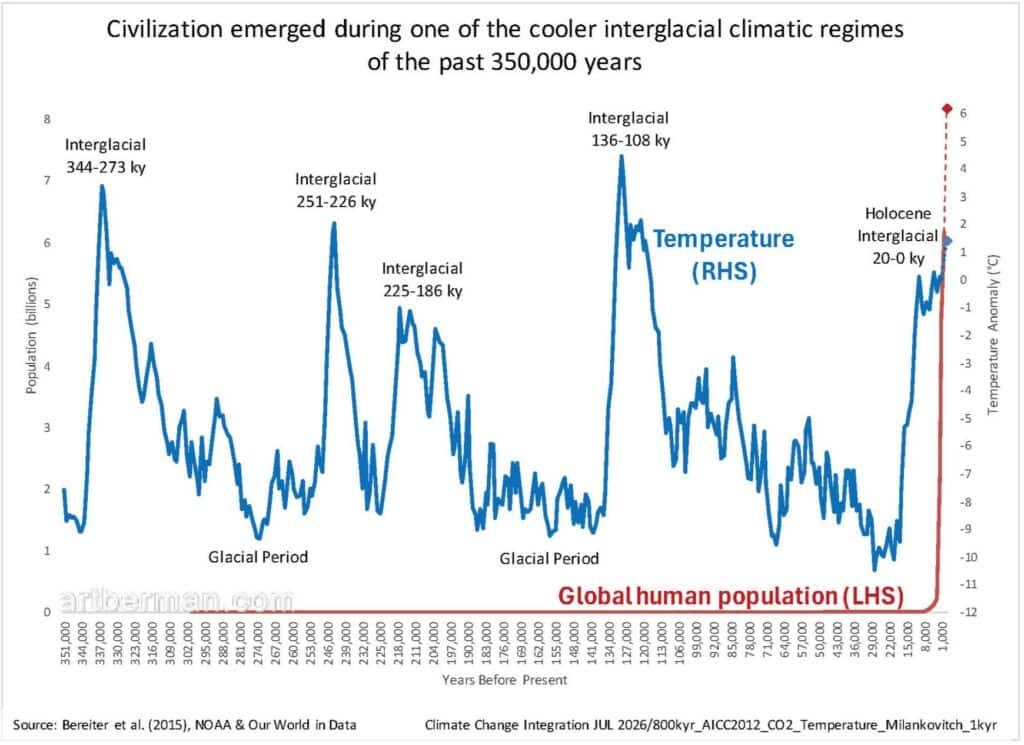
When I look at the chart below—a 350,000-year history of climate and humanity—a few things stand out. Warmer interglacial periods alternated with colder glacial periods.
For almost all of that time, the human population remained remarkably small. Our ancestors survived repeated swings between colder and warmer climates, but they lived in small, mobile groups. They weren’t supporting cities, global trade, electric grids, or eight billion people.
Then, during the Holocene, something fundamentally changed. Agriculture emerged. Settlements became cities. Complexity increased. Population exploded. Civilization developed during a relatively cool interglacial period that avoided the highest temperatures reached by several earlier interglacials.
That doesn’t prove climate caused civilization. Nor does it prove that warmer temperatures are incompatible with civilization.
It does point toward a more interesting question.
Can a civilization that emerged under one climatic regime adapt to another, especially when change occurs rapidly?
It’s also one we should be able to explore together—with curiosity, humility, and a willingness to follow the evidence wherever it leads.
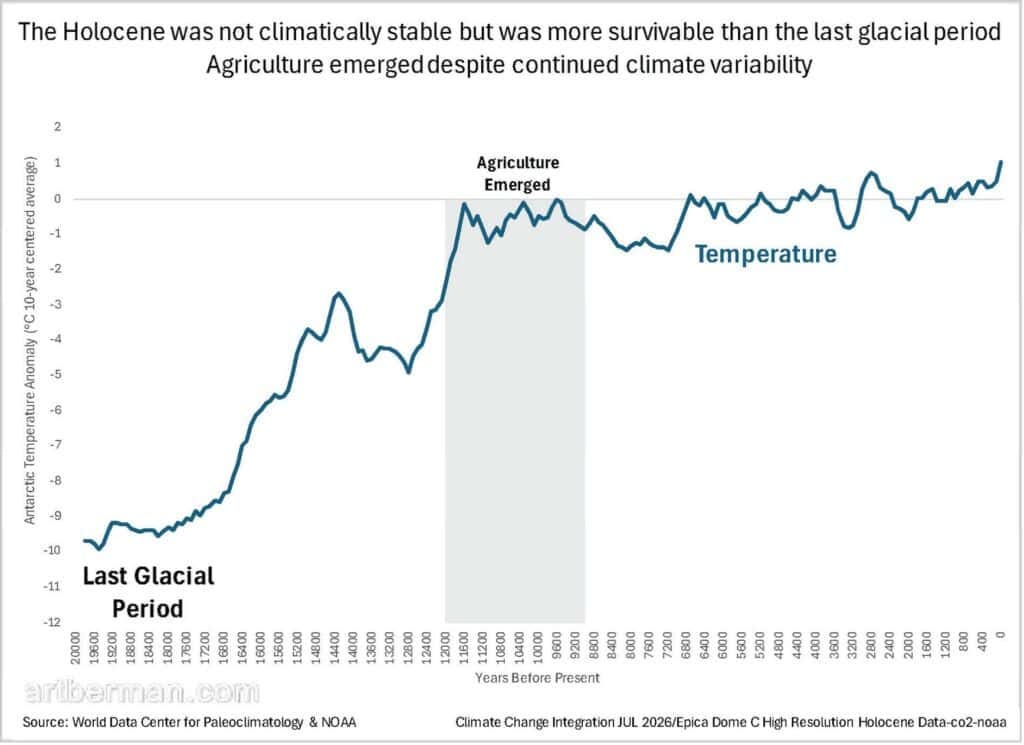
Now let’s zoom in and look at the Holocene—the period we’re living in today.
As the Earth emerged from the last ice age, temperatures rose rapidly before entering a version of today’s climatic regime about 12,000 years ago, around the same time agriculture began to appear. The climate didn’t become perfectly stable. Temperatures continued to fluctuate, and different reconstructions disagree about exactly how much they varied. What they agree on is that the extreme swings of the last glacial period were over.
Keep in mind that this chart shows 100-year averages, so shorter-term fluctuations are smoothed out. If you’re already looking for today’s warming of roughly 1.5°C above pre-industrial levels, it’s blended into the final century on the right. We’ll come back to that later. For now, it’s more useful to focus on the broader story the data are telling.
Many experts argue that the Holocene was an unusually stable period and that this stability allowed agriculture and civilization to flourish. The evidence suggests a more nuanced picture.
The Holocene wasn’t climatically static. Temperatures continued to rise and fall, sometimes substantially depending on which reconstruction you examine. But compared with the violent and prolonged shifts of the last glacial period, the Holocene represented a far more survivable climatic regime.
That distinction is important.
Agriculture didn’t emerge when climate became stable. It emerged during a different climatic regime—one that, despite continued variability, seems to have provided conditions compatible with farming, permanent settlements, and increasingly complex societies.
The planet was still changing. It was simply changing within limits to which civilization could adapt.
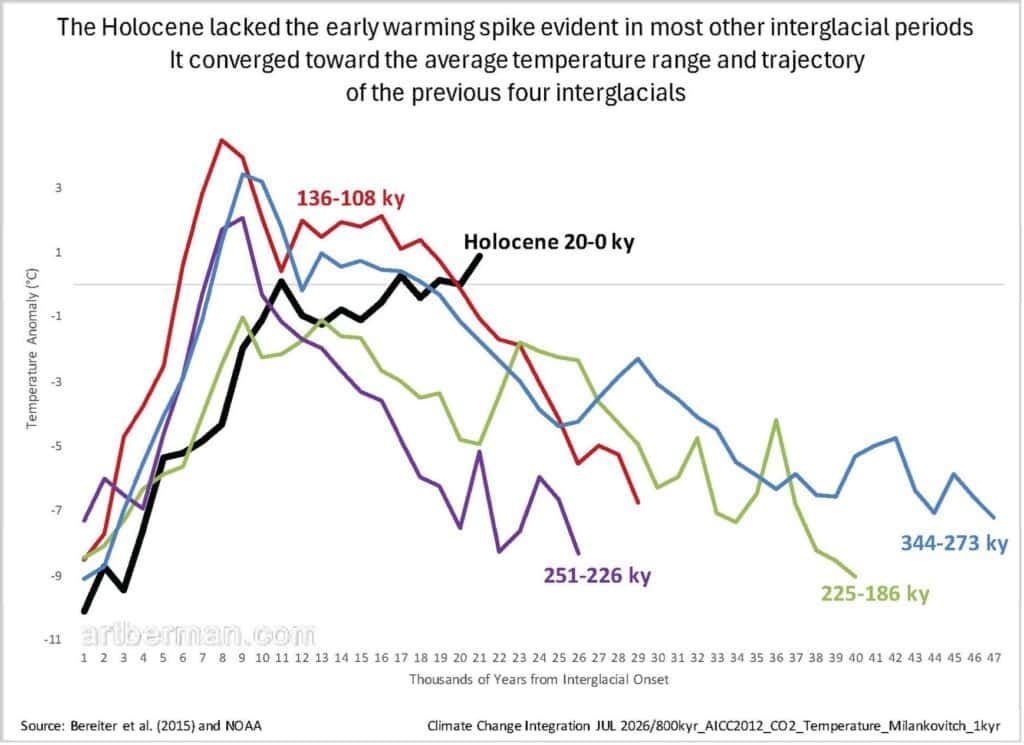
Rather than assuming the Holocene was unusually stable, let’s compare it with previous warm periods. Fortunately, we have reasonably good climate records from the previous four interglacial periods. In the chart below, the Holocene is shown in black.
The similarities are immediately apparent, but so are the differences. Like the earlier interglacials, the Holocene began with rapid warming as the Earth emerged from an ice age. All five belong to the same family of climatic regimes. Unlike most of the earlier interglacials, however, the Holocene lacked a pronounced early warming spike. Instead, temperatures continued to rise more gradually while most of the earlier interglacials had already begun cooling.
Perhaps the most interesting feature is what happened over time. Rather than diverging from earlier interglacials, the Holocene gradually converged toward the central tendency of the previous four interglacials. It never reached the highest temperatures of the warmest interglacials, but neither was it fundamentally different. It occupied the cooler end of the interglacial family while remaining well within its overall range of behavior.
That observation suggests a more nuanced conclusion than the familiar story of an exceptionally stable Holocene. The climate continued to change, but it changed differently—and within a climatic regime in which agriculture, cities, and eventually global civilization emerged.
So where does this popular idea of a “stable Holocene” actually come from?