
A Deep Time Perspective on Climate Change

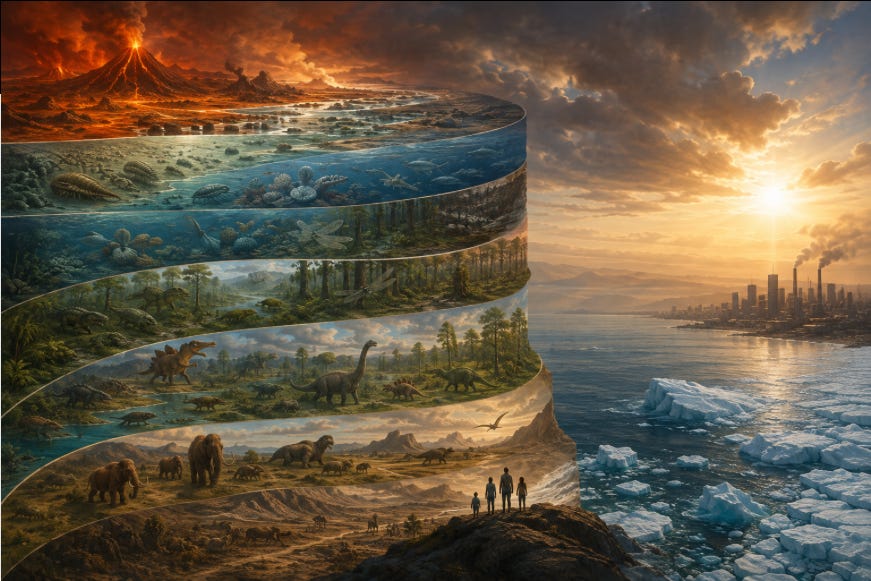
Earth’s history over the last 4.5 billion years—from volcanic upheavals and drifting continents to the evolution of climate—has been shaped by a simple thermodynamic reality: Earth is hot and space is cold. Like every hot object, our planet continuously loses heat as it moves toward equilibrium. The atmosphere, oceans, continents and carbon cycle are not separate stories but different expressions of that long process.
Earth’s core is nearly 6,000°C while the background temperature of space is only a few degrees above absolute zero. That enormous thermal gradient powers mantle convection, which drives plate tectonics. Plate tectonics, in turn, reshapes continents and ocean basins, influences volcanism and weathering, and regulates the long-term carbon cycle. Ocean and atmospheric circulation redistribute heat around the globe. Greenhouse gases affect how efficiently heat escapes to space. Water vapor responds to temperature. Methane responds to ecosystems that themselves respond to climate. Milankovitch cycles change the geographic and seasonal distribution of incoming solar energy. Each operates differently and on different timescales, but all participate in the movement and transformation of energy through the Earth system.
Climate is the evolving expression of these interacting processes. Most climate stories begin in the present and project forward to a future of increasing risk. That’s an important story, but it’s like beginning a book with the second-to-last chapter. I’d rather start at the beginning.
Figure 1 shows a reconstruction of global mean surface temperature over the last 485 million years—nearly the entire history of complex animal life. The most striking observation is that Earth has spent far more time in climates warmer than today’s than in climates resembling the present. The only comparably cold interval occurred more than 275 million years ago.
The Phanerozoic temperature record is not a story of progressive cooling. It includes at least two major cooling episodes separated by a prolonged return to very warm conditions. Earth cooled through the late Paleozoic, reaching cold conditions during the Carboniferous and Permian, before warming again through much of the Mesozoic. Temperature eventually reached a maximum during the mid-Cretaceous about 94 million years ago. A second great cooling trend followed, extending toward the present but interrupted by episodes of abrupt warming, including the Paleocene-Eocene Thermal Maximum about 56 million years ago.
Ancient life evolved across this extraordinary range of temperatures. Humans arrived only near the extreme right edge of Figure 1, during the cool and highly variable Pleistocene. The final point in the reconstruction is about 5,800 years ago, approximately coincident with the emergence of the earliest civilizations. The dashed line marks the pre-industrial average temperature around which civilization subsequently developed and expanded. Human civilization, in other words, arose during an unusually cool chapter of Earth’s history.
Broadly speaking, the Phanerozoic alternated among three climate regimes: a warm or hothouse Earth, a cold or icehouse Earth, and intermediate conditions. Hothouse worlds lacked permanent polar ice and had much higher global temperatures. Icehouse worlds supported large continental ice sheets and, within them, repeated glacial and interglacial cycles. Intermediate climates occupied the territory between those states.
The differences were enormous. Hothouse conditions averaged more than 25°C globally, compared with about 14°C during coldhouse conditions. Earth occupied a hothouse state for nearly 60% of the last 485 million years, while icehouse conditions accounted for only about 11%.
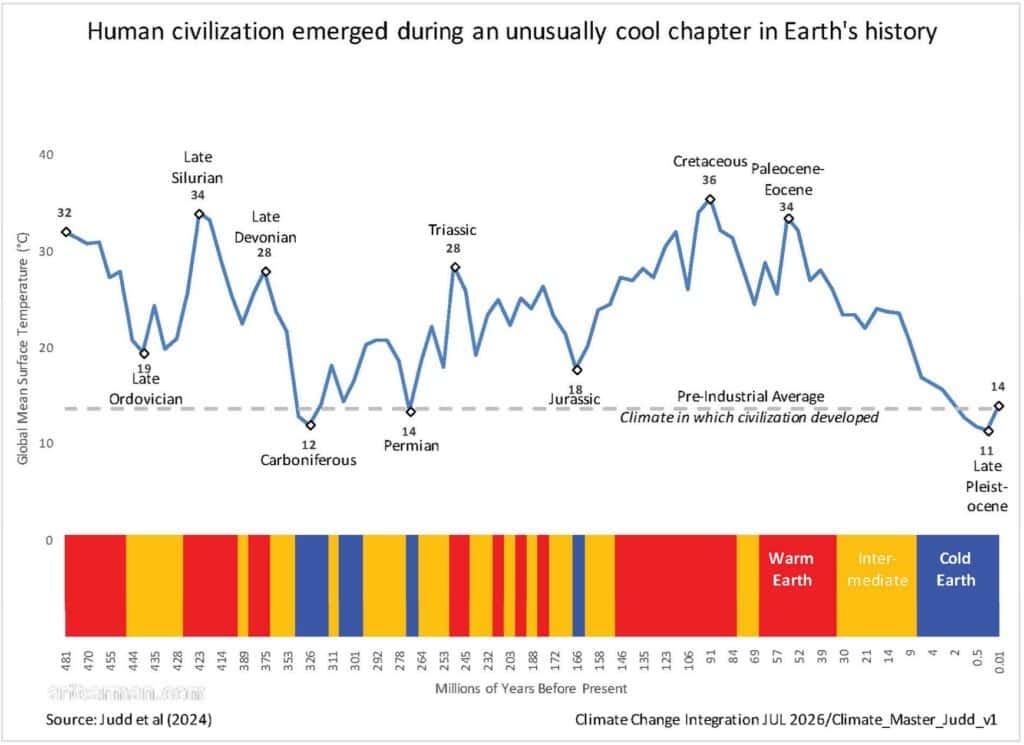
An obvious question is how we can possibly know any of this. There were no thermometers for almost all of human history, and there weren’t even humans for almost all of the period shown in Figure 1.
We know far more about ancient climate than the absence of thermometers might suggest. Judd and colleagues assembled nearly 120,000 carefully screened temperature estimates from geological and fossil evidence spanning the Phanerozoic. They reconstructed where those samples were located on the ancient Earth and combined them with climate models using sophisticated data-assimilation methods similar to those used in modern meteorology.
The result is not a 485-million-year thermometer record, nor does it pretend to be one. It is a reconstruction built from an extraordinary body of evidence, and uncertainty increases as we move deeper into geological time. Different methods disagree about some absolute temperatures, particularly during very warm periods, but the broad succession of warmer and colder climate states is considerably more secure. We cannot know every detail of Earth’s past, but we know its broad outlines remarkably well.
Another obvious question raised by Figure 1 is what caused global temperature to rise and fall by more than 20°C across the Phanerozoic. To answer that, it helps to begin with a more fundamental question: what conditions made life on Earth possible in the first place?
That is a vast subject I will not attempt to cover comprehensively, but two essential ingredients are clear: liquid water and carbon. Carbon is abundant in Earth’s rocks and circulates among the solid Earth, oceans, atmosphere and living things. Water presented a different puzzle.