
Beyond Surplus
Rethinking How Civilizations Rose

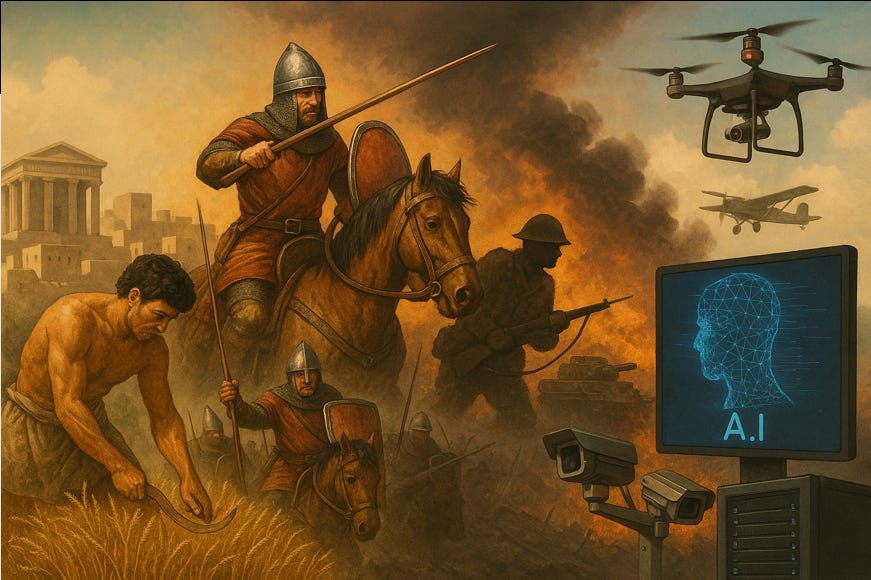
The surplus story most of us learned is straightforward. Once humans learned to farm, they grew more food than they needed. That extra food freed some people to build, rule, trade, fight, worship, create, and learn. Crops led to cities, cities led to states, and states led to progress. Surplus, we’re told, made civilization.
Some of that is true but when you look at the data as Peter Turchin has, the story doesn’t hold up completely. Agriculture didn’t automatically create prosperity or stable societies. In fact, most early farmers lived hard lives of subsistence. What really transformed human society was war.
After climate stabilized about 10,000 years ago, farming spread across Eurasia and Mesoamerica. Populations increased, but settlements often grew and then collapsed. Instead of steady expansion, early agricultural societies were unstable. Turchin’s data shows that military technology, not surplus, was what really drove large-scale polities. People could loot their way to prosperity.
Around 2000 BCE, bronze cavalry appeared. It was a step forward, but bronze was expensive and soft, so its use was limited. The real breakthrough came around 1000 BCE when cavalry armed with iron weapons appeared. Iron made swords and spearheads cheap and plentiful. Horses brought speed and shock. Villages had to band together into larger states to survive. Surplus mattered, but mostly as the tax base for soldiers and horses. The real driver was the pressure that new weapons put on society.
The next breakthrough was gunpowder and oceangoing ships. By the late 1400s, Europeans had mastered ocean navigation. In the next century, muskets and cannon-equipped fleets gave small European countries global reach. They could control trade routes, seize colonies, and build empires far larger than their populations could support. Human looting went global.
Turchin and his colleagues call this 2000-year process the rise of “war machines.” These weren’t just armies but systems of extraction and organization. They combined soldiers, bureaucrats, taxes, and ideology into one structure. A successful war machine did more than win battles—it reshaped whole social orders.
This perspective also challenges the usual story about fossil fuels and the Industrial Revolution. The standard account says coal and oil unlocked vast new energy, machines multiplied productivity, and prosperity spread. That’s true, but incomplete. What this account leaves out is the role of military technology. Turchin ends his analysis before the Industrial Revolution, so this is my extension of his framework.