
The Energy Transition That Never Was

For more than two decades, governments, international agencies, and corporations have promoted the false hope of an “energy transition.” History shows otherwise. There are no examples of true transitions—only new energy sources added on top of old ones.
The theory was that if we replace fossil fuels with renewables, emissions will fall and the climate-change problem is solved. But the reality is that no credible outlook shows fossil fuel use falling enough to reduce emissions in a meaningful way.
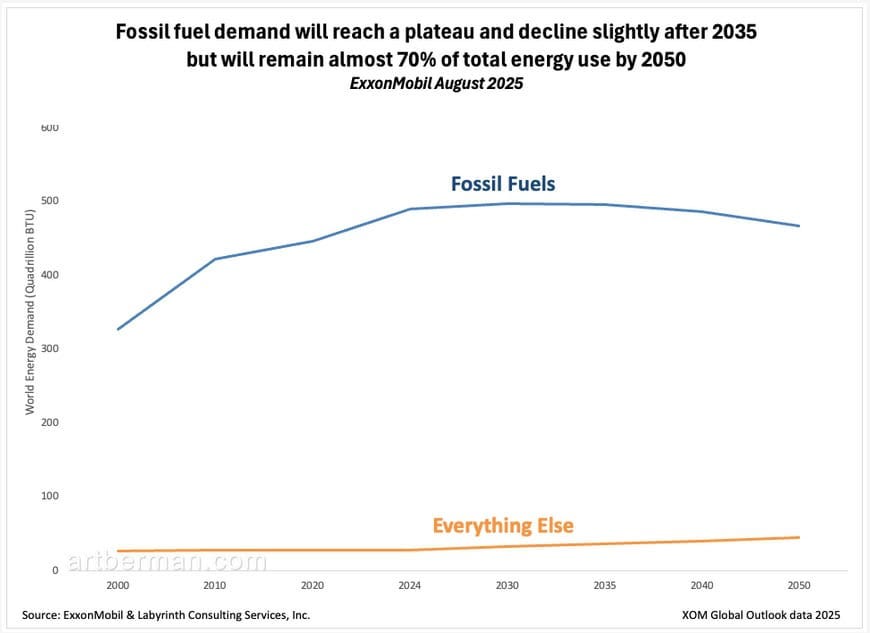
ExxonMobil’s Global Outlook 2025 paints a grim picture for those who believe in a real transition to renewables. There’s no “peak demand” for fossil fuels—only a plateau, with a slight decline after 2035, but fossil energy still makes up nearly 70% of the energy mix in 2050 (Figure 1).
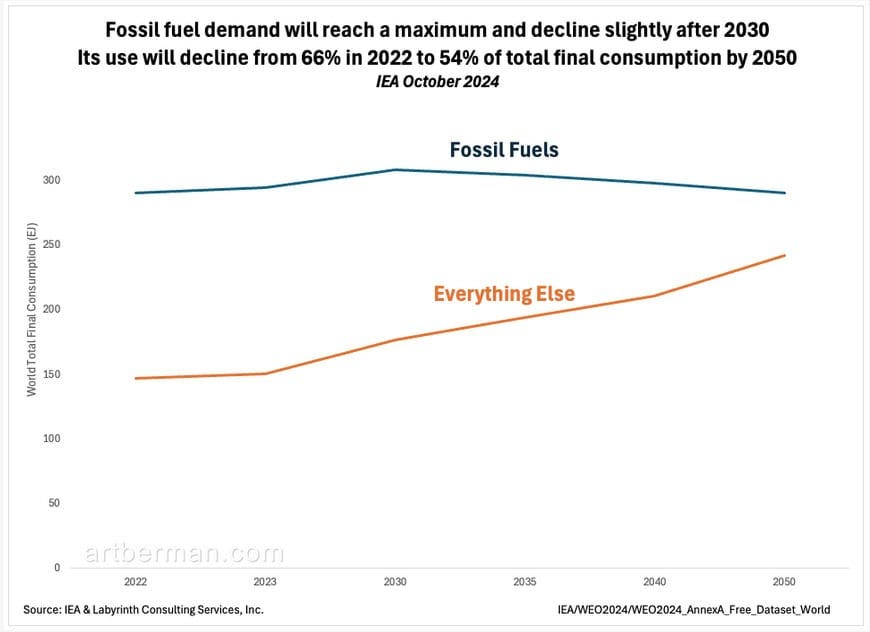
The IEA’s World Energy Outlook 2024 shows a similar path, with stronger growth in non-fossil energy, but fossil volumes barely move—meaning emissions remain stubbornly high (Figure 2).
The deeper problem is scale. Both projections assume total energy use keeps rising, which means a larger human footprint: more extraction, more waste, more pressure on ecosystems. Even if the mix shifts slightly toward non-fossil sources, the overall scale drives ecological overshoot. Worse, both forecasts assume global GDP doubles by 2050, a bet that rests on cheap, abundant energy. But affordability is already breaking down. If energy use stalls, so will GDP. That may ease pressure on the planet, but it introduces another layer of economic fragility.
French President Macron warned in 2022 that the “era of abundance” was over. Last week, German Chancellor Friedrich Merz admitted that Germany can no longer finance its welfare state from domestic output. That crisis is rooted in energy, and it is hard to see how subsidies for renewables can be sustained. After two decades of the Energiewende, fossil fuels still make up about 75% of Germany’s energy use, while electricity prices remain among the highest in the developed world.
Cracks in the transition story are showing up everywhere. The Net-Zero Banking Alliance has lost Goldman, JPMorgan, Citi, HSBC, and Barclays. Ørsted, once the darling of green finance, has lost 86% of its value since 2021 because of rising costs, broken supply chains, and political hostility. Corporate sustainability has flipped from bold pledges to retreat. Oil companies like BP that once championed net-zero roadmaps are retreating to core oil and gas projects. AI has stolen the investment spotlight, and ESG has lost its shine.