
Why Isn’t Earth Frozen?

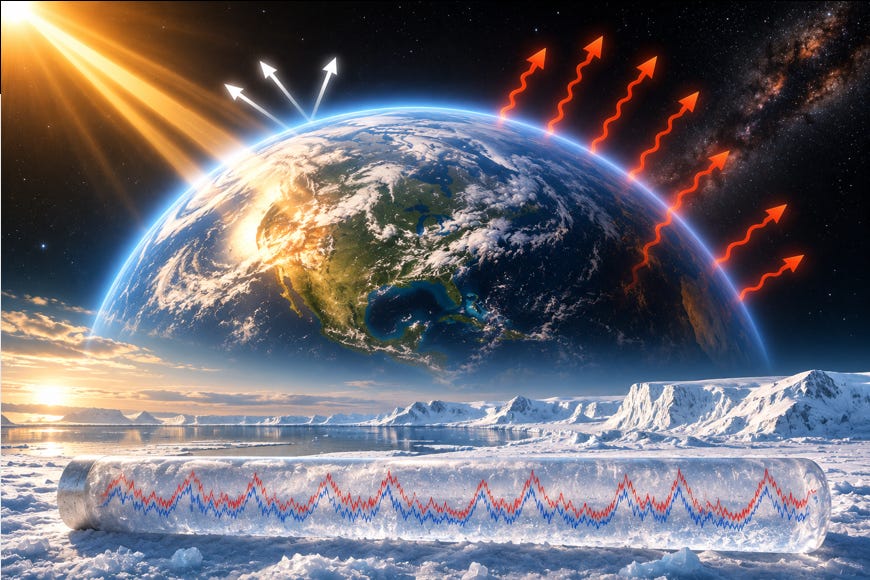
A little more than 200 years ago, the French physicist Joseph Fourier recognized a mystery. According to simple physics, Earth should be as cold as the Moon.
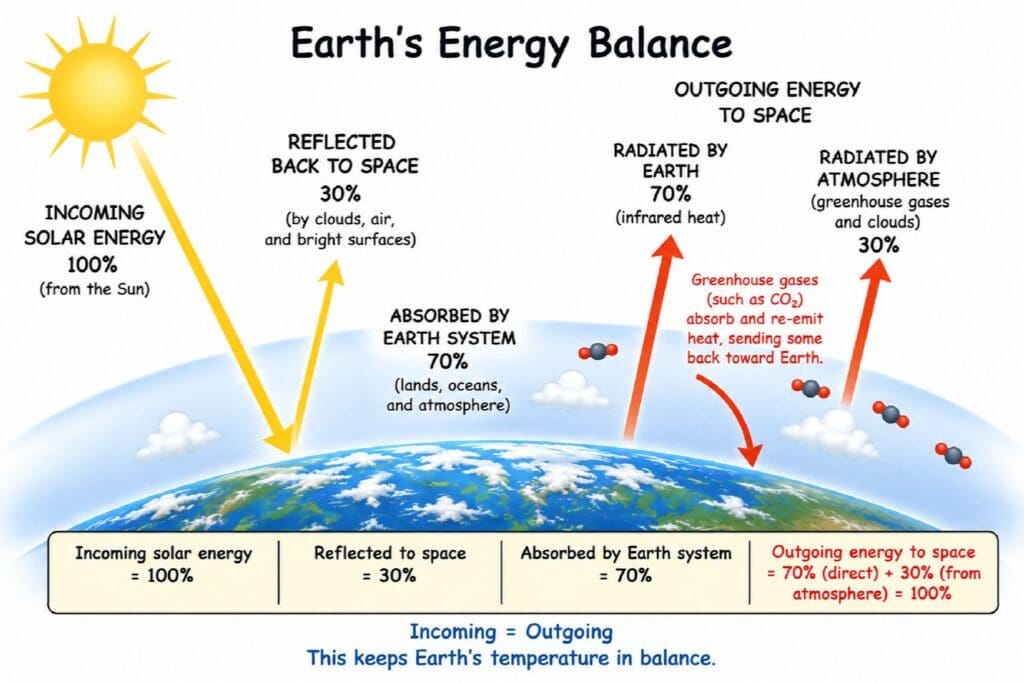
Fourier calculated Earth’s energy balance (Figure 1). About one-third of incoming solar energy is reflected back into space by clouds, the atmosphere, and bright surfaces such as ice. The remaining two-thirds is absorbed by the land, oceans, and atmosphere, warming the planet. That energy is eventually radiated back into space as infrared heat. Over long periods, incoming and outgoing energy must balance.
Yet when Fourier did the calculations, something didn’t add up. The math predicted that Earth’s average surface temperature should have been about –18 °C (0 °F)—similar to the airless Moon. Instead, observations showed an average temperature of about 15 °C (59 °F). Something in Earth’s atmosphere was keeping the planet about 33 °C warmer than simple physics predicted.
Decades later, the British physicist John Tyndall set out to identify what that “something” was. In 1859 he built an instrument to measure how different gases interact with infrared heat. Oxygen and nitrogen—the gases that make up almost all of the atmosphere—proved largely transparent. Tiny amounts of water vapor and carbon dioxide, however, absorbed heat very effectively. Tyndall had identified the missing ingredient in Fourier’s mystery.
Swedish scientist Svante Arrhenius approached a different question: what caused the ice ages? Building on Tyndall’s work, he proposed that changes in atmospheric carbon dioxide—then thought to result largely from variations in volcanic activity—could explain Earth’s swings between glacial and warm periods. In 1896 he estimated that reducing atmospheric CO₂ by about one-third would cool the planet enough to expand the great ice sheets, while doubling CO₂ would produce the opposite effect. He later recognized that industrial coal burning was also adding carbon dioxide to the atmosphere and concluded that human activity was making another ice age less likely.
Remarkably, the scientific investigation of what we now call the greenhouse effect began as scientists pursued entirely different questions. Fourier wanted to understand Earth’s temperature. Tyndall wanted to understand radiant heat. Arrhenius wanted to explain the ice ages. None regarded greenhouse gases as an environmental threat.
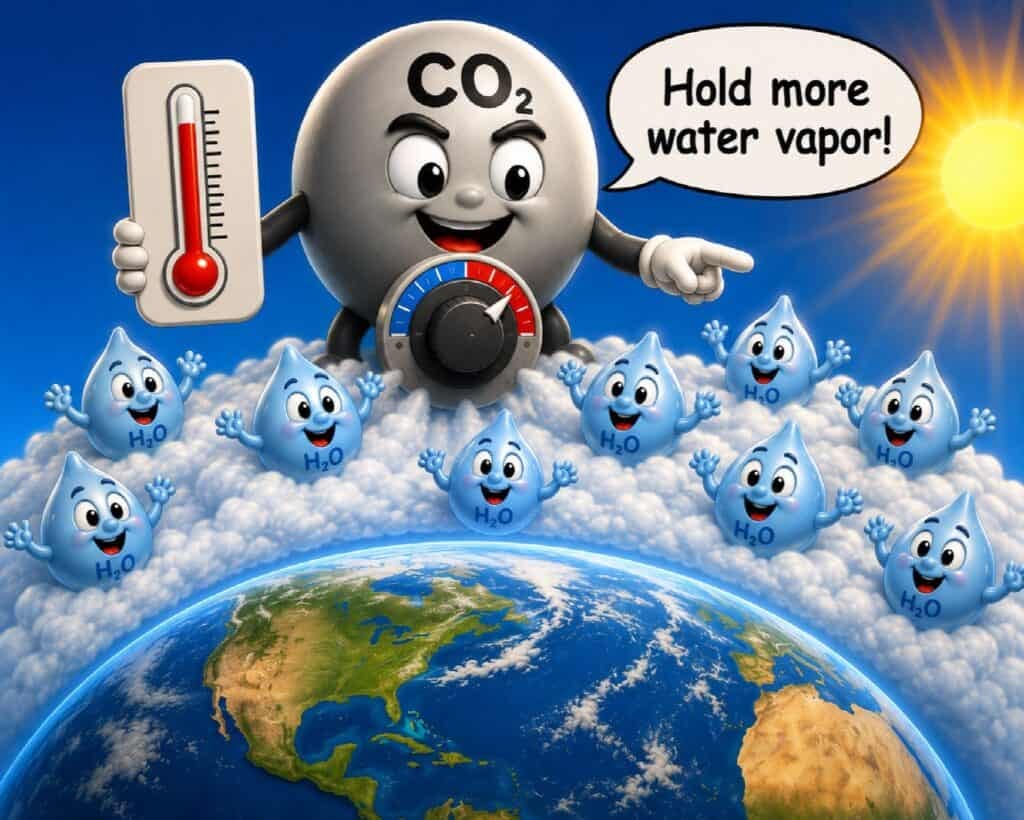
Figure 2 picks up where the story leaves off. It shows how Earth’s atmosphere regulates the planet’s temperature.
The little blue characters represent water vapor. Together they form a blanket around Earth that slows the escape of heat into space. Because water vapor is the most abundant greenhouse gas, it does most of the actual work of keeping the planet warm enough for liquid water and life.
Carbon dioxide, however, is the thermostat.
As CO₂ increases, the atmosphere warms. Warmer air can hold more water vapor, which thickens the insulating blanket and traps still more heat before it can escape to space.
Think of a home heating system. The thermostat does not produce the heat, nor is it the warm air coming from the vents. Yet by controlling when the furnace turns on, it determines how warm the house becomes. Earth’s atmosphere works the same way: water vapor is the blanket that keeps the planet warm; carbon dioxide decides how thick that blanket will be.
This is why climate scientists describe water vapor as a feedback and carbon dioxide as a forcing. Water vapor does most of the warming because there is so much of it. Carbon dioxide sets the temperature that governs how much water vapor the atmosphere can hold.
The important point is not that CO₂ is the largest greenhouse gas—it is not. The important point is that CO₂ controls the thermostat. Water vapor responds.
The first two figures explain why carbon dioxide matters. But has Earth actually behaved this way over geologic time?